Autor: Miragien

  • From Curiosity to Kickoff: The Miragiens Enter Fantasy Football

    From Curiosity to Kickoff: The Miragiens Enter Fantasy Football

    From the Drawing Board to Game Day

    It wasn’t part of a grand plan. It started with a chat at work, a little curiosity, and a spontaneous decision.

    A friend at the office told me about his starting Fantasy Football adventure. The idea sounded intriguing: building your own team out of real NFL players and competing against other teams based on their performances on the field.

    I was interested. But I also knew that American football was complicated enough already. Did I really want another hobby that would demand hours of research, statistics, and weekly decisions?

    Then an unexpected message arrived: a spot was about to open up in the Gang Green Germany Fantasy Football League.

    Sometimes, you just have to say yes.

    And just like that, the Miragiens were born.

    As you may already have discovered, Mirage is the name of our second sim racing team, founded back in 2001. (More of our history here)

    At first, I briefly considered calling the team the RaceCars, after our sim racing A-Team. After all, sim racing is where all our e-sports activities began, back in a time when the term itself wasn’t even a thing yet.

    But the name would have needed a little too much explaining. Miragiens sounded more elegant and had an identity of its own. It also felt like a natural fit because Miragien is already my nickname — making me a Miragien myself, and very much part of the team.

    So the distinction felt right: Team RaceCar for sim racing, Équipe Mirage for everything else in e-sports.

    So, what exactly is Fantasy Football?

    Imagine being the general manager of your own American football team. You don’t sign real contracts or build a stadium, though. Instead, you select real NFL players for your virtual roster.

    Those players earn fantasy points through their performances in actual NFL games — by throwing touchdowns, catching passes, running with the ball, and much more.

    Each week, your team faces another manager’s team. The players‘ performances are converted into fantasy points, and whoever scores more wins the matchup.

    The catch? You don’t control what happens on the field. You can make all the right decisions and still watch your carefully assembled lineup fall apart because a key player gets injured, has a quiet game, or simply doesn’t perform as expected.

    Welcome to Fantasy Football.

    Building a team is half the fun

    For me, one of the most enjoyable parts of this adventure began long before the first kickoff.

    Anyone familiar with Équipe Mirage or Team RaceCar will probably understand why. In sim racing, designing cars, developing liveries, and creating a visual identity for a team have always been among my favourite parts of the hobby. Daniel and myself spent hours discussing about details of the livery of our cars.

    So why should Fantasy Football be any different?

    The Miragiens needed more than a name on a league table. They needed an identity of their own: a badge, team colours, a uniform, and, naturally, a helmet.

    Fortunately, we already had plenty of heritage to draw on. The colour palette combines the Soleil yellow that makes a Mirage car stand out on the racetrack with white and shades of blue inspired by the RaceCars.

    The badge shows the sun rising over the Mediterranean. We look out from a sheltered bay towards the open sea, with pine trees on the left and a Mediterranean village on the right. At the heart of the rising sun sits the RC logo — a small connection between this new adventure and the team’s roots.
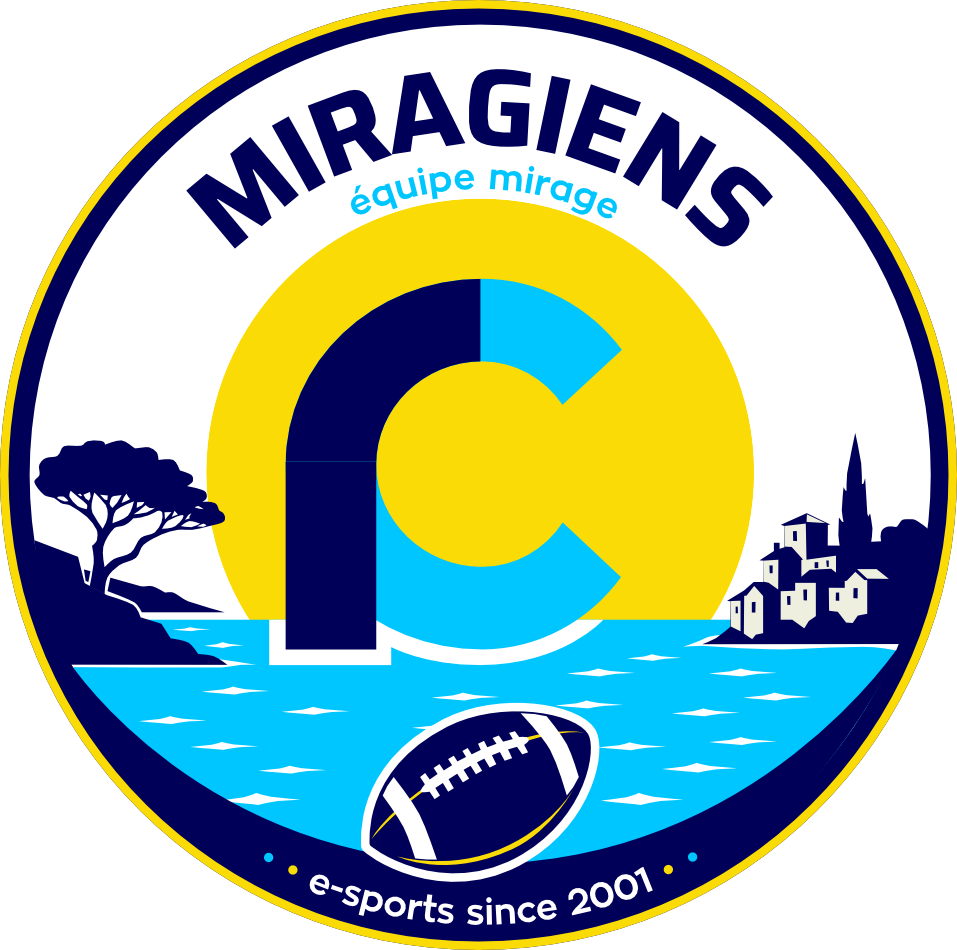
    The uniform carries the same visual language: a dark blue base, complemented by accents of Soleil yellow and azure. Clean, bold, and unmistakably connected to our racing heritage.

    The helmet, in particular, pays tribute to one of the greatest drivers of all time: Ayrton Senna. His iconic designs have inspired generations of racing fans, and we wanted to capture a little of that spirit in our own helmet. Of course, we couldn’t resist adding our own twist. We adapted the colours to fit the Mirage identity, bringing a touch of our Mediterranean-inspired style to a classic racing look.

    The result is a design that looks back to the legends of motorsport while giving the Miragiens an identity of their own.
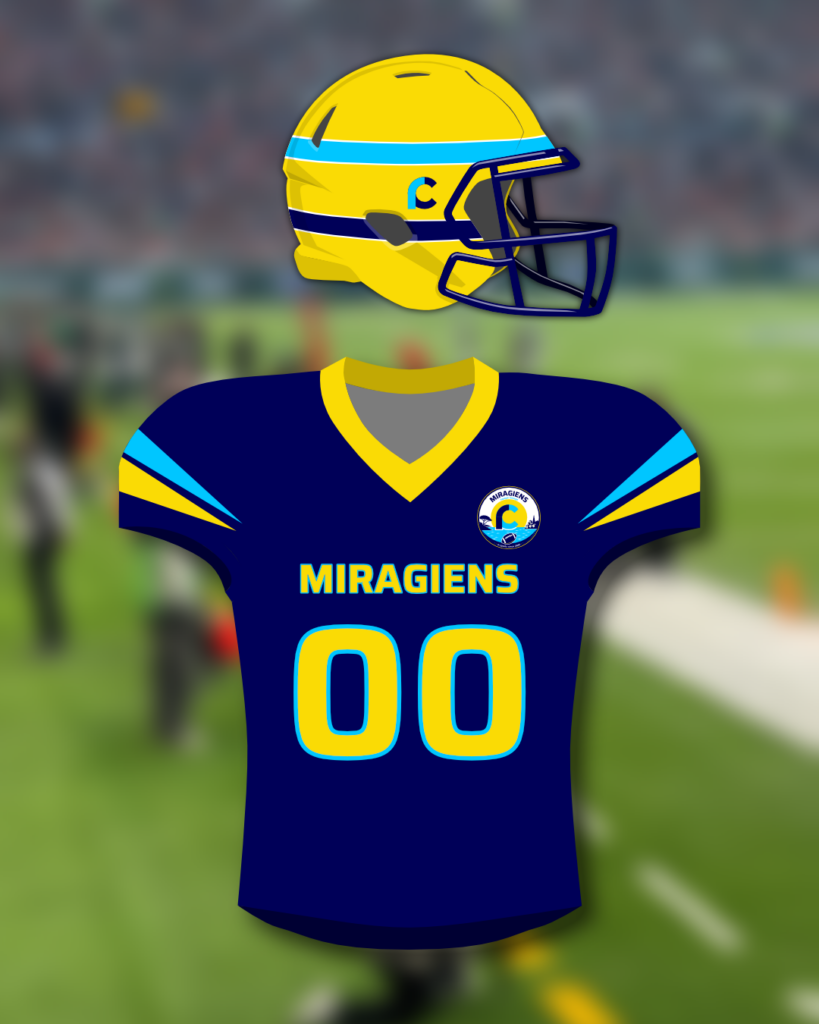
    The result is a small design project in its own right — a way of giving a virtual team something tangible, something that feels like ours.

    Meet the Co-GM

    Of course, designing a great-looking team doesn’t tell you which players to draft.

    That was where the learning curve really began.

    I’ve been following the NFL closely since around 2012, but I’d never really dug into playbooks or studied the different skill positions in detail. I mostly enjoyed the excitement of the game itself — the way a match can remain thrilling right until the final whistle.

    Fantasy Football opened up a whole new side of the sport. Suddenly, I had to understand player roles, statistics, matchups, and all the little details that can make the difference between a good decision and a bad one.

    I found myself a little overwhelmed.

    Once again, my colleague had a suggestion: „Why not use AI?“

    It turned out to be a great idea. I decided to try AI as my co-general manager — a partner to help me understand the rules, explore player options, weigh up decisions, and prepare for the draft.

    Not an oracle that knows exactly what will happen, but an assistant that can explain the reasoning behind a decision — and occasionally play devil’s advocate when I’m too convinced that my own idea is the right one.

    It has been an interesting experiment: learning a new side of a sport I’ve enjoyed for years, navigating unfamiliar terminology, and making sensible decisions without pretending to be an expert overnight.

    It’s also a fascinating opportunity to explore the possibilities — and limitations — of a technology that everyone seems to be either hyping up or worrying about.

    The draft: easier said than done

    Then came draft day.

    It wasn’t quite like the movies, but the setting was almost perfectly suited to our badge: sitting on a terrace in Sardinia, with local Ichnusa beer and grissini on the table. Around 30°C, the Mediterranean summer all around us, and a Fantasy Football draft on the screen.

    The draft is where every manager builds their initial roster, selecting players one by one while the rest of the league competes for the same pool of talent. Preparation matters, but so does flexibility — because the player you want might be gone before your turn comes around again.

    I knew it would be exciting. I hadn’t quite appreciated how stressful it would be.

    Fifteen roster spots to fill, eleven other managers competing for players, just two minutes to make each pick, and the constant feeling that there was something important I hadn’t considered.

    So there I was, enjoying the Mediterranean summer while trying to figure out which NFL player would help the Miragiens win their next matchup.

    A rather unusual holiday activity — but a memorable one.

    Eventually, the Miragiens had their team.
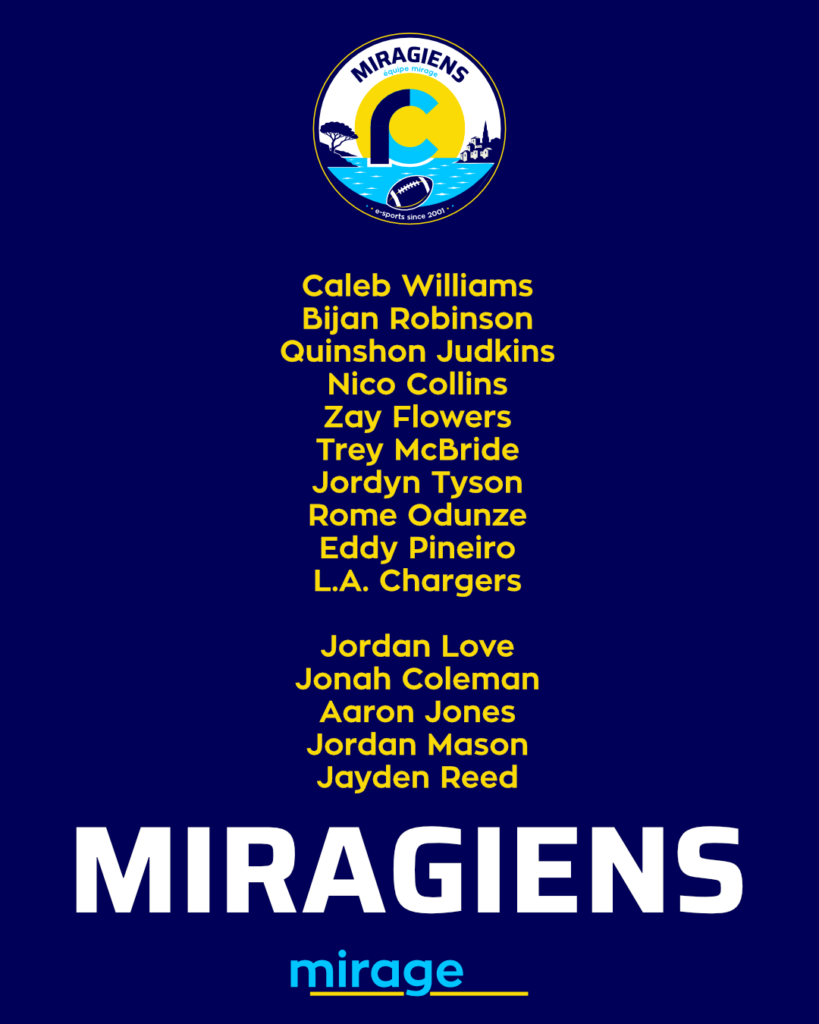
    The Miragiens‘ roster after the draft, heading into Week 1

    And then the season began.

    An opening win — and a reality check

    The first matchup brought a rather unexpected victory. Not a bad start for a rookie manager — and the first outing of Équipe Mirage in the world of Fantasy Football.

    But Fantasy Football has a way of bringing you back down to earth rather quickly.

    The following weeks brought the less glamorous side of managing a team: injuries, questionable player statuses, difficult lineup decisions, and the realisation that a promising roster can look very different from one Sunday to the next.

    Sometimes you make the right call. Sometimes you get it wrong. Sometimes you spend far too long debating two players, only to discover that neither was the answer.

    And then there’s the way you watch football itself. You sit down to enjoy an NFL game, only to find yourself checking Sleeper every few minutes to see how your players are doing.
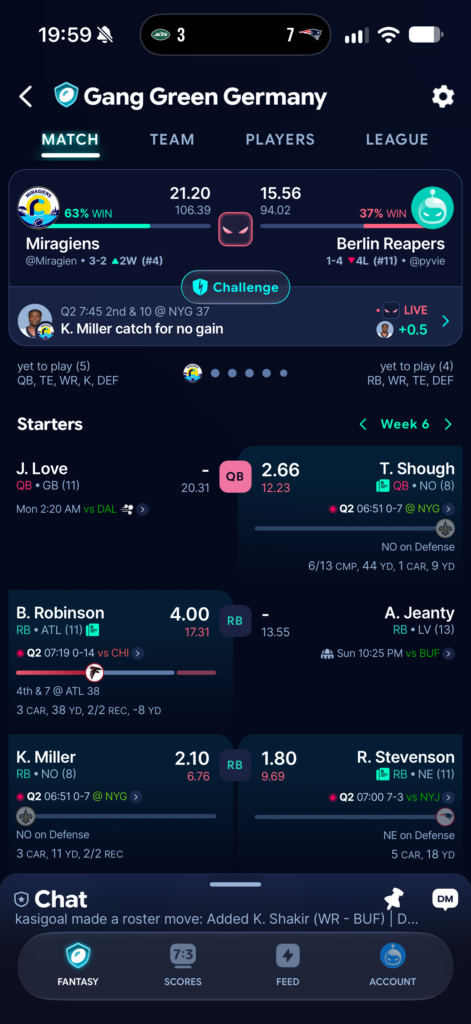
    My typical smartphone screen on game day this season: the real game on TV, while keeping a close eye on the Miragiens‘ standings in the Gang Green Germany league via the Sleeper app. Because watching football is only half the fun now.

    You might even find yourself cheering for points scored by the Chicago Bears — not necessarily because you’ve become a Bears fan, but because one of their players happens to be helping your fantasy team.

    Fantasy Football has a funny way of … slightly adapting your loyalties, at least for a few hours on Sunday.

    And sometimes, all you can do is laugh about it.

    The Miragiens are still learning. So am I.

    The season is just getting started

    What began as a spontaneous yes to an open spot in a fantasy league has turned into a new little chapter for Équipe Mirage.

    There’s the sporting side — getting to know the NFL even better, understanding the numbers, and trying to outscore the competition. There’s the strategic side — making decisions with incomplete information. And then there’s the creative side, which feels wonderfully familiar from our sim racing adventures.

    Will the Miragiens become a Fantasy Football powerhouse? Far too early to tell.

    Will there be more design experiments, questionable decisions, and dramatic Sunday afternoons? Almost certainly.

    For now, we’re enjoying the ride.

  • Racing on Battery – But Not the Way You’re Thinking

    Racing on Battery – But Not the Way You’re Thinking

    As the automotive industry continues its transition towards electric vehicles, we have already seen several attempts at battery-powered racing – Formula E, Extreme E, and since 2026 even Formula 1 with an increased share of electric power.

    Last week, we had another attempt at battery-powered racing – although this one was entirely unplanned.

    Brands Hatch Race

    Daniel and Felix met for a few training sessions in ACC (originally to test Assetto Corsa Evo, but the download took too long). On short notice, they decided to join a race on a public server.

    Felix had never raced at Brands Hatch in ACC before, but as it is not the most difficult circuit to learn, it proved manageable with some support from Daniel.

    Training and qualifying were busy sessions with lots of traffic and plenty of lessons learned, but the results were encouraging: pole position for Daniel in the RaceCar and P4 for Felix in the Mirage.

    The target for the race was clear: avoid collisions, bring both cars home cleanly, and then see what would happen. The race distance was set to just 20 minutes.

    Following the conservative strategy, both cars had a cautious start and lost a few positions in the opening corners. Daniel stayed in the fight for the lead, while Felix had his first incident in Surtees Corner. Forced to brake by a Porsche ahead, the Porsche itself failed to make the corner and clipped the Mirage from the side.

    After the collision, which cost several positions, the race settled down a little. Daniel patiently kept the pressure on until the race leader finally made a mistake and spun, promoting the RaceCar into the lead. Sadly, the celebration didn’t last long, as Daniel also spun shortly afterwards and dropped back into second place. Felix worked his way back through the field, but when battling for P3 he was not patient enough. At Hawthorn Bend he tried to pass a Ferrari, but the gap simply wasn’t wide enough. While the Ferrari managed to stay on track, the Mirage spun around and the chance for P3 was gone.

    But things were about to get even worse.

    While fighting with overheated tyres, a warning suddenly appeared:

    „Notebook battery running low.“

    Well… that certainly explained the poor performance and the rather low FPS. Since there was no way to fix the problem while driving, the only option was to hope that the battery would last until the chequered flag.

    For the team, it was already the second energy-related issue after Daniel’s fuel problem at the Nürburgring race. Luckily, with just 5% battery remaining, Felix managed to cross the finish line in P4, complementing Daniel’s podium finish in P2.

    Red Bull Ring Race

    There was still enough time for a second race that evening, this time at the Red Bull Ring in Austria. The battery issue had been solved (by plugging the notebook in properly), allowing both drivers to start qualifying with full performance.

    The field was rather small, with only two other cars joining, making it feel more like a training session under race conditions.

    Daniel qualified on pole, Felix lined up in P2, and the first non-RaceCar entry was a McLaren in P3.

    Daniel won the start, while Felix’s hopes for a clean race ended in the Rindt Corner when the McLaren made contact while fighting for P2.

    After that incident, the McLaren showed that it was clearly the fastest car on track. However, repeated excursions beyond the track limits and an aggressive driving style eventually resulted in a spin at Turn 1 (Niki Lauda Corner), allowing Daniel to retake the lead after several laps of close racing. Meanwhile, Felix enjoyed a relatively quiet race with consistent lap times. A second spin from the McLaren eventually promoted him to P2.

    The final lap became interesting once again. The McLaren was gaining almost half a second per lap and quickly filled the mirrors of the #18 Mirage. Once again, everything was decided in the Rindt Corner, but this time it was the McLaren that ran wide, followed by a high-speed spin, allowing Felix to secure second place.

    In the end, it turned into an enjoyable evening of testing after two exciting races – against the other cars… and the battery.

  • Comeback by accident

    Comeback by accident

    For the first time in years, yesterday Équipe Mirage had its comeback on the racetrack in an actual race. Interestingly, that happened by accident…

    Background

    In simracing, Équipe Mirage complements our classic simracing team Team RaceCar. In the past, that became necessary whenever we had more drivers than available slots in one team — so a “B-Team” had to be created. That happened for the first time back in 2001, when Dahie and myself wanted to start in a hotlap competition where only two drivers per team were allowed.

    The last time we had more drivers than slots for Team RaceCar and therefor the need for Équipe Mirage to appear was during the German Simracing Formula Masters (DSFM) back in 2012.

    Comeback

    Yesterday evening, there was the comeback. When designing the liveries for our latest GT3 cars, Daniel always created a Mirage variant as well. That was originally meant more as a design study than with the concrete plan of actually using it. But as we all love the yellow-blue design, I used it during our more-or-less regular test sessions.

    Such a test session happened yesterday and while chatting about our lives, Dahie and myself did not realize that we were not on a training server, but in an actual qualifying session preparing for a race — on the Nordschleife!

    For me, it was the first online race in ACC and therefore also the first race for our yellow Mirage RC-24-EM.

    Race Report

    As most of you probably know, the Nordschleife is quite long. The 24h version of the track which was used is a combination of the Nordschleife itself and the entire Grand Prix course, resulting in a combined length of 25.378 km.

    That means that for short races like ours, an actual qualifying session is nearly impossible. Thirty minutes are hardly enough for an outlap and one timed lap when a single lap takes about eight minutes — especially if something goes wrong and you need to restart your lap.

    In the end, the only car in the field of 10 to complete a timed lap was car #47 — the RaceCar RC-24-EM driven by Dahie — meaning pole position for the race.

    I was not able to finish my lap in the Mirage, as I had a severe crash at Galgenkopf after which I aborted the lap. But ACC counted that as “nearly completed” — or at least I progressed further than the others — meaning I could complete the front row on starting position 2.

    As that was my first online race in ACC — and my first online race in years in general — I instantly got a bit nervous. Dahie explained some basic knowledge about the starting procedure and there we go.

    As common in GT3 racing, it was a flying start, so Dahie set the pace and I needed to keep up with him until the green flag appeared. To be honest, it was already quite a challenge to stay correctly positioned and avoid receiving an early penalty for failing to do so — but it worked out.

    The green flag appeared and obviously both Dahie and myself still need to improve our reactions, as the Porsche 911 GT3 behind us overtook both of us almost immediately. No problem, as our main goal was simply to finish the race — especially on such a demanding track where we lack experience.

    Start of the race: The green 911 already got in between Dahies white RaceCar and my yellow Mirage.

    Running in P3, I approached Turn 1 conservatively on the inside when I suddenly got a massive impact at the rear of the car. Some colleague must have seriously missed the braking point. But as GT3 cars are quite massive, it was not that big of a deal and I recovered in P5.

    Huge impact during breaking for the first corner…

    But then the first deal breaker came over the Discord channel: by accident, Dahie had fueled only 2 liters — which would only allow him to make it around the Grand Prix section. Anyway, he tried his best to come back to the pits, but it was not possible to enter the pit lane (just like the Abt Lamborghini during the 2026 Nürburgring 24 Hours). As there was no chance to complete a fuel-saving lap around the Nordschleife, he decided to respawn, causing around 90 seconds of time loss — but at least he could continue.

    Dahie let me pass as he was trying to save some fuel…

    My own race was actually going quite well. I felt surprisingly comfortable and had no real issues from the rear damage.

    A RaceCar and a Mirage side by side in an actual online race – first time since 2012!

    At the Aremberg right-hander, the Porsche 911 appeared again in my mirrors (surprisingly, as he had already overtaken me right after the green flag), but as he was clearly faster I let him pass shortly after the corner. It would not matter for long anyway, as I still only wanted to finish the race — currently running in P6.

    After Bergwerk I was suddenly P4, obviously because two competitors had lost their cars somewhere on the track, so I gained two positions.

    But only until I got on the throttle too early at the exit of the Caracciola-Karussell: I got massive oversteer which led to a spin on the track. That cost me one position — back to P5.

    Now things became more difficult. I felt quite safe on the first half of the track, but after the Karussell the Nordschleife becomes much harder. A lot of difficult-to-remember — and even harder-to-learn — tight corners, elevation changes and blind sections. I nearly lost the car several times, but when I approached the Sprunghügel I suddenly was in P2. I overtook one car on track, but I honestly do not know what happened to the others.

    The joy did not last long: as I had already done several times during training sessions, I was too fast in the left-hander before Schwalbenschwanz and crashed into the guardrail. Result: a bent front axle. I decided to stop for repairs, even though that would obviously cost me contact to the front-runners and P2.

    I somehow survived the Döttinger Höhe and entered the pit lane. Next issue: during training sessions the pit speed limiter is activated automatically — during races it is not. So I rushed into the pit lane at far too high speed.

    The repairs went well, but then I got the bad news: DSQ for speeding in the pit lane. My first race in years ended after just one lap.

    My Mirage with a few „minor“ battle scars at pit lane entry – the worst is yet to come…

    As it is not particularly meaningful to argue with a computer program, I left the car and decided to check what the sister car with Dahie on board was doing. I saw that he had taken over P2, as nearly all the other guys had lost their cars as well.

    Dahie finished the race, proving that he’s exactly where he belongs in the A-Team’s car. 😉

    In the end, Dahie managed to finish the race in 2nd place — all in all not great as only 2 cars managed to finish the race, but at least we learned one important thing: races are fun, so we should keep doing them.

  • 25 years of Sim Racing

    25 years of Sim Racing

    It all started in 2001.

    Back then, online gaming was still in its early days, and simracing looked very different from what we know today. Daniel and Felix joined a Hotlap Competition of the online magazine Racingmag, taking their first steps into a world that would become a lasting part of their lives.

    There was no grand plan, just a shared passion for motorsport, a fascination with racing simulations, and the idea of building something together.

    When Liveries Became Our Shared Identity

    One of the first results of that journey was the RaceCar RC-09 — our first jointly designed virtual racing car. It marked the beginning of a tradition of designing cars, competing in leagues, learning from one another and, above all, having fun along the way.

    RaceCar RC-09 in Geoff Crammond’s Grand Prix 3 – That was how simracing looked back in 2001

    Over the years, Team RaceCar became our home in competitive simracing. From offline hotlap competitions to international racing leagues, from the early Grand Prix simulations to modern racing simulators, the technology changed dramatically. The spirit behind it did not.

    And neither did the friendship.

    In the picture above, you can see the two founders of both Team RaceCar and Équipe Mirage — Daniel (right) and Felix (left) — together with a wonderful hand-painted portrait of our very first simracer: the elegant RaceCar RC-09.
    Even after all these years, this car remains a special part of our history. It marks the beginning of a journey — and, more importantly, a friendship that continues to this day.

    The birth of Équipe Mirage

    In most leagues back then, teams were limited to just two drivers. Team RaceCar was already at capacity in the Hotlap Competition (HC), so a second team became a practical necessity. Équipe Mirage was our way of keeping everyone involved.

    Our first race took place on the streets of Monaco, so a French name felt like a natural fit in an otherwise predominantly English-speaking simracing world. And mirage — a fata morgana — seemed particularly fitting for a world built around virtual racing.

    What began as a companion to the main team developed its own identity, its own cars and its own place in our shared history. The yellow-and-blue Mirage designs became a familiar counterpart to the classic RaceCar colours.

    Today, Équipe Mirage carries that heritage forward. It complements Team RaceCar in simracing while opening the door to other sporting and e-sports activities — a broader playground for the same curiosity, creativity and competitive spirit.

    More Than Racing

    Looking back after more than 25 years, the cars, races and results are only part of the story.

    There are the evenings spent designing liveries, the conversations that went far beyond racing, the projects that worked out and those that did not, and the friendships that grew along the way. Some things have changed, others have remained remarkably constant.

    That continuity is something we value. We have never been a commercial esports organisation, and we have no ambition to turn this into something it is not. We do this because we enjoy it — because there is always another idea to explore, another car to build, another race to enter, or simply another evening to spend together.

    The next chapter

    This website is a place to collect some of those stories. Not just race reports and simracing history, but also the sporting activities, experiences and little adventures that make up the world of Équipe Mirage and Team RaceCar.

    Our roots lie firmly in simracing, and Team RaceCar remains an important part of that story. Équipe Mirage is the natural extension of the same spirit: a little more room to experiment, to explore and to try something new.

    More than 25 years have passed since those first laps in 2001. We are still here, still curious, and still enjoying the journey.

    If you are interested in more details about our simracing history, feel free to visit the website of Team RaceCar.
    We also recommend taking a look at Dahie’s personal blog and, if you enjoy Mediterranean cooking, our sister project Mirage Cuisine might have something for you as well.

    Thanks for stopping by — and welcome to Équipe Mirage!

    Interested in joining us? Get in touch — we’d love to hear from you.